
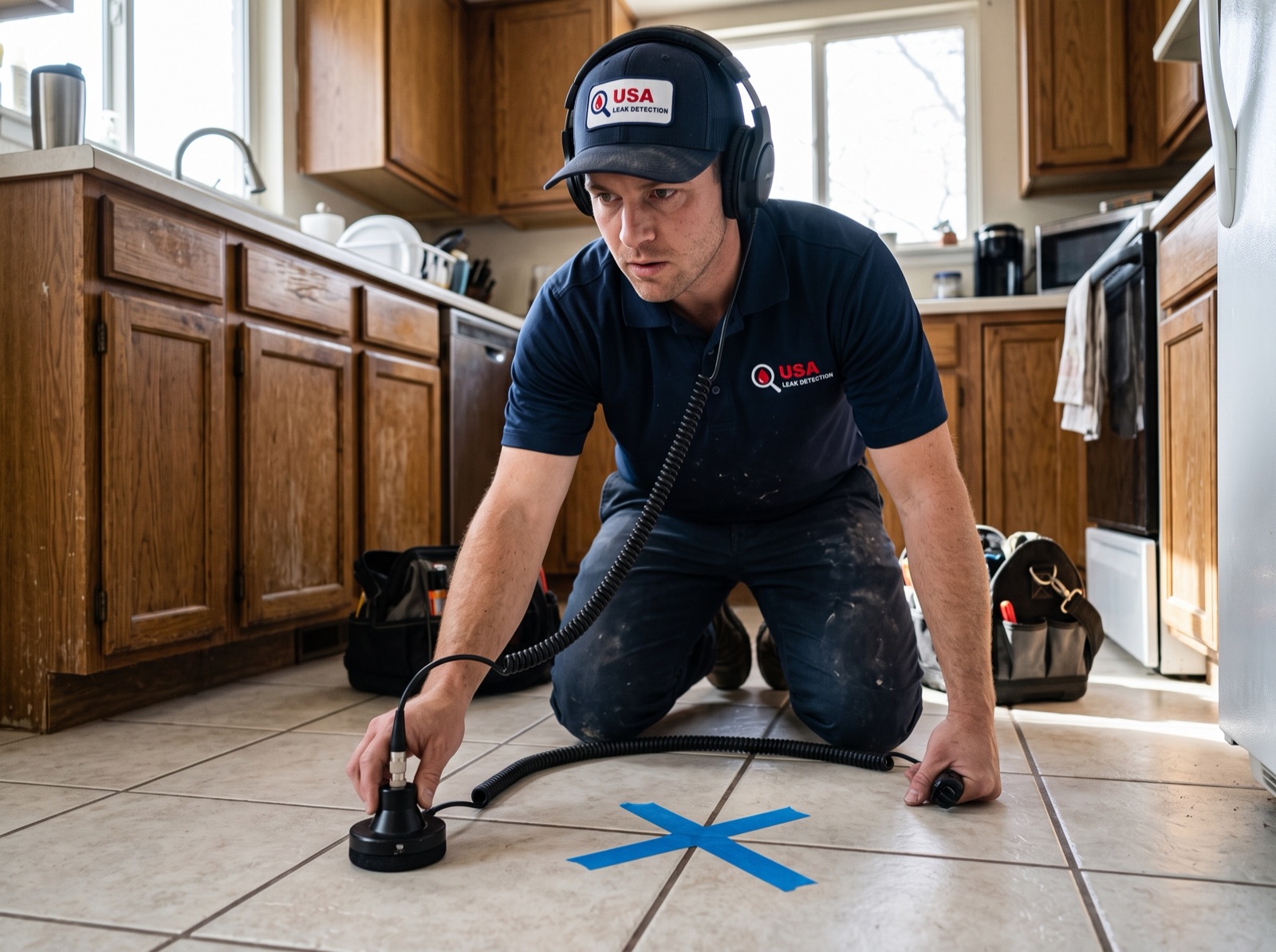
Slab leak detection in Denver starts with one question: where is the water going? Our office sits on East Evans Avenue in southeast Denver, and our team works across the city. We find the leak before anyone breaks concrete.
In Denver, slab leaks often sit under floors built on swelling clay. Front Range clay swells when it gets wet and shrinks when it dries. Colorado’s moisture swings make it far more common here than in wetter states. The Colorado Geological Survey calls it one of the state’s most costly geologic hazards. [1]
This page covers how we find slab leaks, what causes them, and your repair options. Our work is plumbing-focused leak location, so the repair decision rests on a confirmed leak, not a guess. Call (303) 953-8631 or use our contact page to book a visit.
How Do You Detect a Slab Leak in Denver, CO?
Detection follows a set order, starting with the simple checks:
- Shut off every fixture and read the water meter. Movement with everything off points to a leak.
- Check the floor for warm spots, damp flooring, and cracks along the walls.
- Check the pressure regulating valve and the water heater for scale and leaks.
- Confirm where the slab sits using the floor plan, the furnace room, and the garage.
- Pinpoint the leak with listening and scanning tools.
- Mark the leak path on the floor before any cutting, then agree on the repair route.
Clay Soil Under Denver Slabs Moves Pipe
Clay under a Denver slab does not hold still. It swells when wet and shrinks when dry, and the slab moves with it. That movement puts stress on supply lines at joints, cracks, and where pipes pass through walls.
A crack or a damp spot on the floor is often the first sign. The real question is whether soil movement or a pinhole caused it. We answer that before we choose any repair.
What homeowners don’t realize is that the movement shows where the stress sits. Start at the cracks and the wall line. Skip the middle of the floor.
Detection Locates the Leak Before Concrete Is Opened
Detection narrows the leak down to one spot. We use meter readings, floor checks, and listening or scanning tools. The concrete stays whole until we confirm that spot. And a confirmed spot means we cut only what the repair needs.
Homeowners often call for one of three reasons. The water bill jumps, they hear running water with no fixture on, or warm spots show up on the floor. Each one is reason enough to check the slab.
Many Denver homes have basements, so confirm the slab first. If the water turns up in a basement, see our basement leak detection page instead.
Denver’s water comes from mountain reservoirs such as Dillon and Gross. The house regulator deserves a look before anyone blames the slab.
One thing to check on Denver calls is the regulator. A failed one sends full line pressure into slab runs. The joints under the slab are where it lets go.
Repair Options Depend on Where the Leak Sits
Some slab leaks get a spot repair at an accessible point. Others need the line rerouted. Pipe material and leak location decide which route fits.
Homeowners often ask if the floor has to come up. The honest answer depends on the leak. Some slab leaks can be fixed without jackhammering, and others can’t.
But a repair that ignores the cause can see the same run fail again. Clay movement opens joints in the same places, so the same run can give out again. A plan built around the actual leak location avoids tearing out more floor than the leak needs.
For the pipe side of a leak, see our pipe leak detection page.
Winter Slab Leaks Show Up in Garages and Unheated Runs
The frost line here sits 36 inches below finished grade. The winter design temperature is 1 degree F, and weathering exposure is severe.
Slabs under heated living space rarely freeze. The lines that burst are the unheated ones:
- Garage slabs
- Exterior hose bibs
- Patio runs
- Any line that crosses a cold wall or unheated space
Knowing which lines run through cold space tells you where to start. On a winter call, we check the garage and the exterior hose bibs before we scan the living room floor.
Older Denver Homes Carry Different Pipe Risks
Pipe material depends on when the house went up. Older homes can have galvanized supply lines, polybutylene, or Orangeburg sewer pipe. Newer builds usually have PEX or copper.
If you own in Park Hill or Washington Park, expect older pipe. Stapleton and Green Valley Ranch are newer master-planned builds, so expect PEX or copper there. Knowing the pipe material shortens the search and guides the repair decision.
On polybutylene homes, we check the fittings and crimp joints first. That is where those lines most often give out.
Frequently Asked Questions
How Do You Detect A Leak In A Slab?
You detect a leak in a slab by shutting off every fixture and reading the water meter. Listening and scanning along the path the water takes comes next.
How Long Can A Slab Leak Go Undetected?
A slab leak can go undetected for a long time when water runs under concrete and never surfaces. Warm spots, damp flooring, and a higher water bill are the usual first signs.
Can You Fix A Slab Leak Without Digging?
You can fix some slab leaks without digging, depending on the pipe material and where the leak sits.
What Causes A Slab Leak?
Shifting clay, pipe corrosion, and high water pressure cause slab leaks.
Will Home Insurance Cover A Slab Leak?
Home insurance covers a slab leak only when your policy allows it. Check the water damage language before you call.