
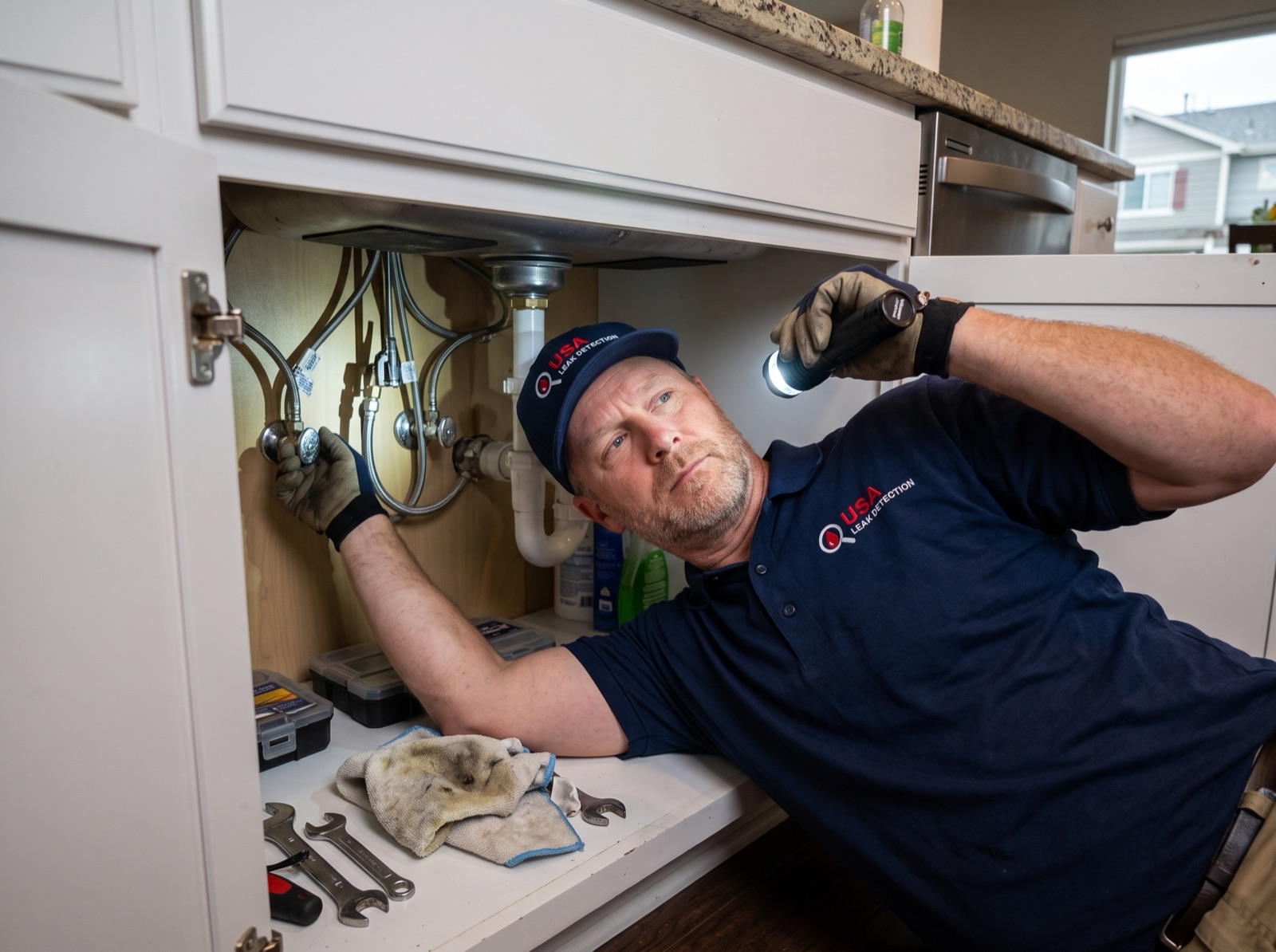
In Denver, faucet leaks often trace back to hard water scale or freezing outdoor lines. Our office is on East Evans Avenue in southeast Denver, and our team works across the city. We check spouts, handle bases, supply lines, and outdoor hose bibs, the spigots you hook a hose to.
You book a visit, and we check the leak before we replace any part. We aim for a repair that fixes the source, not just the symptom. Denver Water averaged 105 mg/L total hardness in 2025 [1], and that scale builds up on cartridges and seats.
Why Is My Faucet Leaking Under the Sink in Denver?
Work through these steps in order. Each one narrows down where the water comes from.
- Dry the cabinet floor and set a towel under the connections.
- Run the faucet for a minute, then check where the water appears first.
- Shut off the supply valves under the sink.
- Snug a dripping compression nut at the shutoff valve, without tightening it too hard.
- If the drip is at the spout or handle base, the valve parts are the likely cause.
- If the leak returns or the source stays unclear, book a faucet leak check.
We check the spout, handle base, and supply lines before we replace any part.
Dripping Spouts Often Start at the Valve Seat
A spout that drips with the handle closed means water is getting past the valve seat or cartridge. Worn washers, O-rings, and seals let it through. Cranking the handle harder will not seal a worn part.
We find the worn part so the repair holds. Denver’s hard water builds scale on valve seats, and that scale can keep seals from closing. Water that shows up somewhere other than the faucet needs a different check, so see our bathroom leak detection page.
One thing we see on Denver calls: a drip that returns after a new washer. Often that means the seat is scaled or pitted. Replace the cartridge or the seat, not just the washer.
Leaks at the Handle Base Point to Worn Seals
Water at the handle base usually comes from a worn O-ring, a cartridge seal, or a loose mounting nut. The spout can leak the same way when its O-rings wear. We aim for a targeted seal replacement, not a full faucet swap.
Quarterly hardness readings in 2025 ran from 55 to 124 mg/L, so the scale load changes through the year.
On a handle leak, we often wiggle the spout while the water runs. If the leak changes, the spout O-rings are the likely source.
Under-Sink Leaks Often Start at the Supply Lines
Water under the sink usually comes from a supply line, a compression fitting at the shutoff valve, or the drain. A constant leak usually points to a split supply line. A leak that shows up only while the water runs usually points to the connection hose inside the faucet.
We pinpoint the exact connection before any part goes in. Older Denver homes may still have original shutoff valves and galvanized supply lines. If the water seems to come from the drain instead, see our drain leak detection page.
What homeowners don’t realize is that tightening a compression nut too hard can crack the ring. Dry each fitting with a paper towel, then snug the nut and recheck.
Denver’s Hard Water Scales Faucet Valves
Denver Water’s report lists hardness as relevant to scale buildup on fixtures [1]. Scale coats valve seats, aerators, and stems. Once it builds up, the parts can’t seal.
So if you keep replacing washers or cartridges, scale may be why the drip keeps coming back. Our repair targets the scale, not just the symptom.
On hard water calls, a white crust around the aerator or valve seat is the giveaway. That crust is scale. Clean it or replace the part before you reinstall it.
Outdoor Faucets Need Freeze Protection in Denver
A dripping hose bib can freeze and split a pipe inside the wall. A frost-free bib keeps its valve inside the heated wall. But a hose left connected keeps water from draining out.
Denver’s frost line sits 36 inches below finished grade, and the winter design temperature is 1 degree F. Homeowners in areas like Stapleton should check outdoor faucets before winter. Fixing the drip before a hard freeze can help prevent hidden damage inside the wall.
One thing we check on frost-free bibs is the stem length and slope. A short stem or a level install lets water sit in the valve.
What to Expect When You Book a Faucet Leak Check
A visit starts with the spout, the handle base, and the under-sink connections. That way the leak location is clear before any repair starts. We explain the fix before we replace any part.
Before the visit, dry the area and run the faucet once. That shows us where the water returns first. Not sure which fixture is leaking? See our home leak detection page.
Our office is at 5800 E. Evans Ave, Suite 203, Denver, CO 80222. Ready to book? Call (303) 953-8631 or book a faucet leak check.
Frequently Asked Questions
Why Does My Faucet Only Leak When the Water Is Running?
My faucet only leaks when water is running because the connection hose inside the faucet has worn or cracked. A leak like this needs that hose checked, not just the spout washer.
Can a Leaky Outdoor Faucet Freeze and Burst a Pipe?
A leaky outdoor faucet can freeze and burst a pipe inside the wall. The damage may not show until spring.
How Do You Find the Source of a Leak Under a Sink?
You find the source by drying the cabinet, running the faucet, and watching where the water returns first. Shut off the valves before you tighten any fitting.
Does Hard Water Cause Faucet Leaks in Denver?
Hard water can cause faucet leaks in Denver when scale builds up on valve seats and seals. Denver Water averaged 105 mg/L total hardness in 2025.