
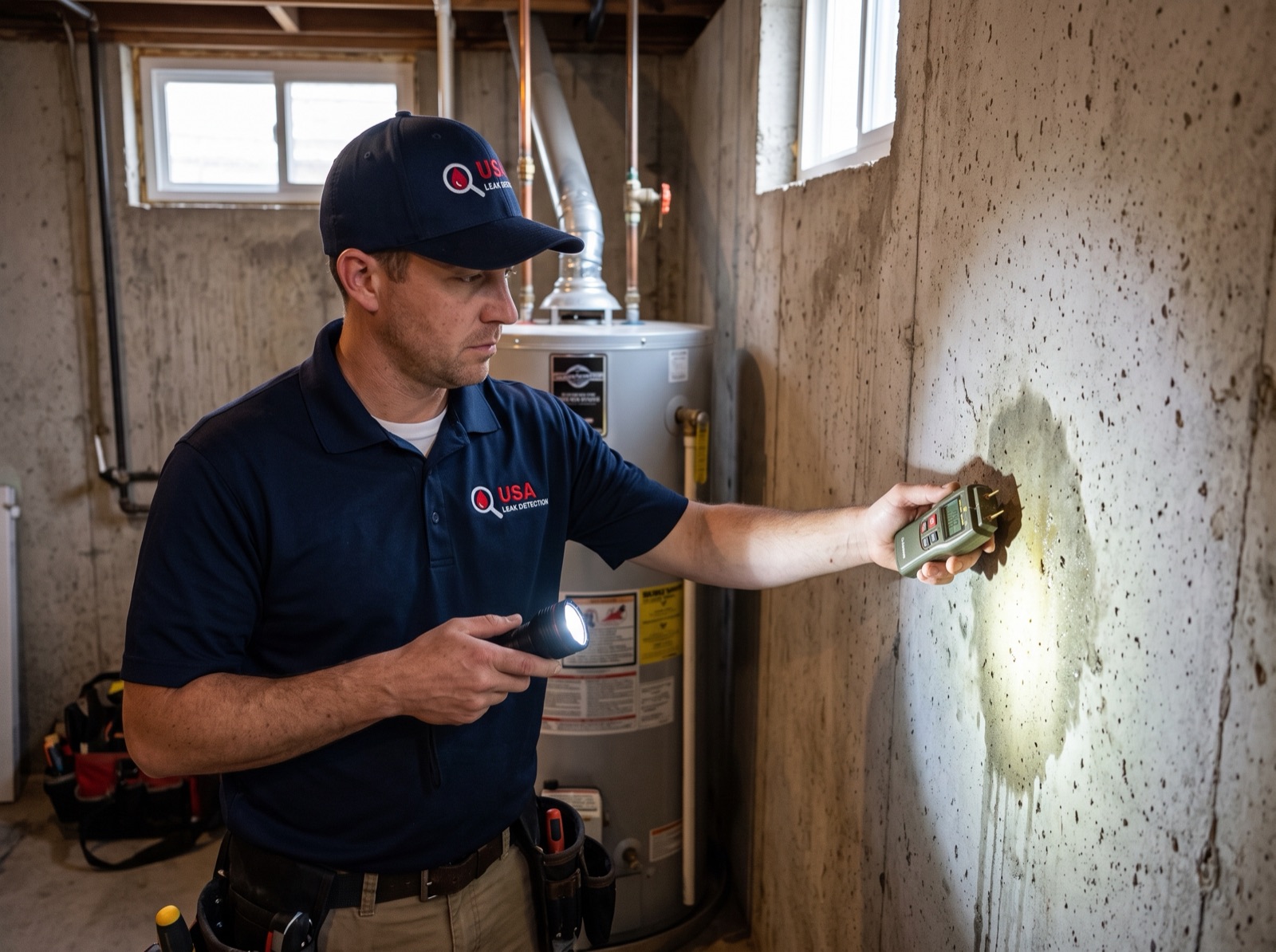
In Denver, basement water can come from a pipe, the soil, or outside the house. Water from each source can look alike on a wet floor. Guessing wastes time and money, so we test before we recommend a repair.
Our office is on East Evans Avenue in southeast Denver, and our team works across the city. We start with the plumbing. Supply lines, drains, water heaters, and sewer lines all get tested before anyone opens a wall. We check groundwater too.
Our visit uses a meter check, moisture mapping, thermal imaging, and pressure tests. You learn the water source before any repair starts. We do not waterproof or repair foundations. We find where the water comes from. To book a visit, contact our team.
How Do You Detect a Basement Leak in Denver?
Here is the sequence we follow on a Denver basement call:
- Shut off the main and read the water meter.
- Mark the wet line on the wall or floor.
- Check whether the meter moves with every fixture off.
- Run moisture mapping across the wall and slab.
- Scan with thermal imaging to trace temperature changes.
- Pressure test the supply line that feeds the wet area.
- Name the source: plumbing, groundwater, or surface water.
The meter test comes first because it separates a supply leak from outside water.
Basement Leak Detection Separates Plumbing Leaks From Outside Water
Basement water comes from plumbing, groundwater, or surface water. Plumbing covers supply lines, drains, water heaters, and sewer lines. Detection names the source before any repair starts, so you do not pay to fix the wrong thing.
Denver Water is mountain surface water. Its total hardness averaged 105 mg/L in 2025, with quarterly readings from 55 to 124 mg/L. Hardness builds scale on fixtures. On a basement walk, that scale shows up as white crust around shutoffs and water heater connections.
Wet concrete can leave a look-alike white crust. We confirm with a moisture meter before anyone calls it plumbing.
Denver’s Swelling Clay Soil Can Look Exactly Like a Plumbing Leak
Swelling clay underlies the major cities along the Front Range, Denver included. Colorado’s seasonal moisture swings make it far more common than in wetter states. The Colorado Geological Survey calls it one of the state’s most costly geologic hazards.[1]
Wetting and drying change its volume, and that movement opens cracks at the cove joint and in block step joints. Groundwater runs through those cracks. Central Park homeowners and other Denver owners may see a wet wall after spring snowmelt or heavy rain. You get a clear answer on soil versus pipe before you pay for pipe work.
What homeowners don’t realize is that a wet wall after a storm is often not a supply leak. A pipe test on that wall wastes a visit.
How Moisture Mapping, Thermal Imaging, and Pressure Tests Trace a Leak
Moisture mapping charts the wet areas across walls and slabs. Thermal imaging shows temperature differences where water moves under concrete. A pressure test checks whether the supply line holds pressure.
If water is under your concrete floor, you want the leak found before anyone cuts it. Together, these tests put the leak on a map, so the repair targets one spot. For water under a slab, see our slab leak detection page.
Swelling clay can crack slabs as well as walls. That is why a pressure test matters here. It tells you whether the pipe or the soil is the problem.
Thermal readings alone can mislead on a slab. The pressure test on the supply line is the check that rules the pipe in or out.
Frost-Line Freeze Damage Shows Up as an Intermittent Wet Spot
Denver’s frost line sits 36 inches below finished grade. The design winter temperature is 1 degree F. Anything buried shallower than 36 inches sits in the freeze zone.
In a hard cold snap, supply lines in the freeze zone can split. So can lines in exterior walls and at hose bibs. Watch the spot where the supply enters the basement through the rim joist, too.
A wet spot that shows in a cold snap and dries by spring often points to a split. We pinpoint that split before the wet spot spreads.
Older and Newer Denver Homes Leak in Different Places
Older homes in Park Hill and Washington Park can still have galvanized supply lines and old drain lines. Newer master-planned areas such as Green Valley Ranch have shorter material histories.
Owners of older homes with a floor drain that backs up should think about the drain line first. A drain leak detection visit can check that run.
What homeowners don’t realize is that Orangeburg sewer pipe is worth checking for in older homes. It fails at the joints and can collapse. A drain that backs up, or a wet spot along a drain run, gets a camera inspection, not a guess.
Owners of newer homes with a wet spot near the water heater or irrigation should check the fittings first. Polybutylene supply lines fail at fittings and crimp rings. A pipe leak detection visit covers that supply run.
Frequently Asked Questions
How Do You Know If Basement Water Is a Plumbing Leak?
You know basement water is a plumbing leak when the meter moves with every fixture off and the main shut. The meter test, moisture mapping, and a pressure test separate a supply leak from outside water.
Why Is Water Coming Through My Basement Wall?
Water is coming through your basement wall because it has a path, such as a crack or a leaking line. Swelling clay can open cracks at the cove joint, and groundwater finds them. A supply leak behind the wall is also possible, so we test before we guess.
Is It Normal to Get Water in the Basement After Heavy Rain?
It is possible after heavy rain, but water that appears only in storms points to outside water. Water that shows in dry weather or with fixtures running points to plumbing.
How Do You Detect a Water Leak Under a Concrete Floor?
You detect a water leak under a concrete floor with a meter check, moisture mapping, and thermal imaging. The pressure test on the supply line is the check that rules the pipe in or out.
How Do You Know If a Basement Is Waterproof?
You do not know a basement is waterproof from one visit, but you do learn where water comes from. We find the source of water. We do not certify waterproofing or repair foundations.